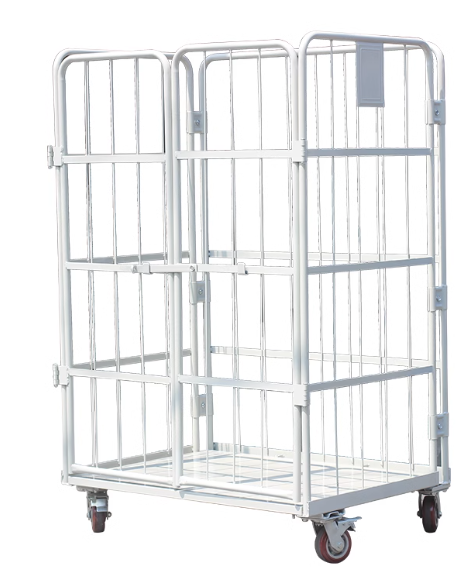


Roll Container
Time:2026-02-11 Source : View:899
Core Features
Material and Structure
1. Material: Typically made of cold-rolled steel or stainless steel via welding, with surface treatments like spray coating or galvanizing for rust resistance, wear resistance, and impact resistance.
2. Frame Design: Features a grid-style fence structure that ensures load-bearing strength while preventing cargo from slipping. Most models support single or double side doors for easy loading and unloading.
3. Caster Configuration: Equipped with 4 standard casters (2 fixed casters + 2 swivel casters with brakes) for flexible movement and stable positioning.
4. Collapsible Structure: The fence can be folded or laid flat when empty, reducing volume by approximately 60%~70% and significantly saving storage and transportation space.
5. Standardized Compatibility: Dimensions are designed to fit pallets, shelves, and other logistics equipment, enabling multi-layer stacking when fully loaded to improve vertical warehouse space utilization.
Functional Characteristics
1. Ideal for short-distance transportation of batch cargo, and can be used with containers like turnover boxes and cartons to achieve efficient "whole trolley" transfer.
2. The height of the fence prevents cargo from tipping over, and the brake-equipped casters secure the trolley during loading/unloading, enhancing operational safety.
3. The metal frame can withstand heavy loads, meeting cargo turnover needs in multiple scenarios such as industry and supermarkets.
Advantages
1. Strong Load-Bearing Capacity: The robust metal frame structure can typically bear 500~1000kg, making it suitable for heavy or batch cargo turnover.
2. High Safety: The fence design prevents cargo from slipping, and the brake casters avoid accidental trolley movement, reducing cargo damage and personnel safety risks.
3. High Space Utilization: The collapsible design significantly reduces storage/transportation costs for empty trolleys; stable stacking when fully loaded improves vertical warehouse space utilization.
4. Efficient Loading and Unloading: The side door design allows direct cargo handling from the side without overhead lifting, and works more conveniently with equipment like forklifts and pallet jacks.
5. Excellent Durability: The metal material is wear-resistant and impact-resistant, with a service life of 5~10 years after anti-rust treatment, far exceeding that of plastic turnover boxes.
6. Strong Versatility: Standardized dimensions are compatible with most logistics equipment, applicable to industries such as e-commerce, clothing, supermarkets, and manufacturing.
Disadvantages
1. Heavy Self-Weight: The metal material makes the trolley itself relatively heavy (usually 50~100kg), requiring more effort for manual movement of empty trolleys and relying on forklifts or pallet jacks for assistance.
2. High Initial Procurement Cost: The manufacturing costs of steel, casters, and anti-rust treatments are high, resulting in a unit price significantly higher than that of plastic turnover boxes.
3. Insufficient Flexibility: The frame structure has poor adaptability to irregular cargo and cannot accommodate overly irregular items; casters are only suitable for flat indoor floors and difficult to move on rough surfaces.
4. High Maintenance Cost: Casters are wear parts that need regular replacement after long-term use; if the metal frame’s paint is chipped due to impact, it is prone to rust and requires regular anti-rust maintenance.
5. Complex Folding Operation: Some collapsible models have multiple folding steps, leading to low efficiency when employees are unfamiliar with the process, and folding components (such as hinges and buckles) are prone to damage.